US Iran Peace Deal Set for Friday Signing in Geneva: All You Need to Know
3 min read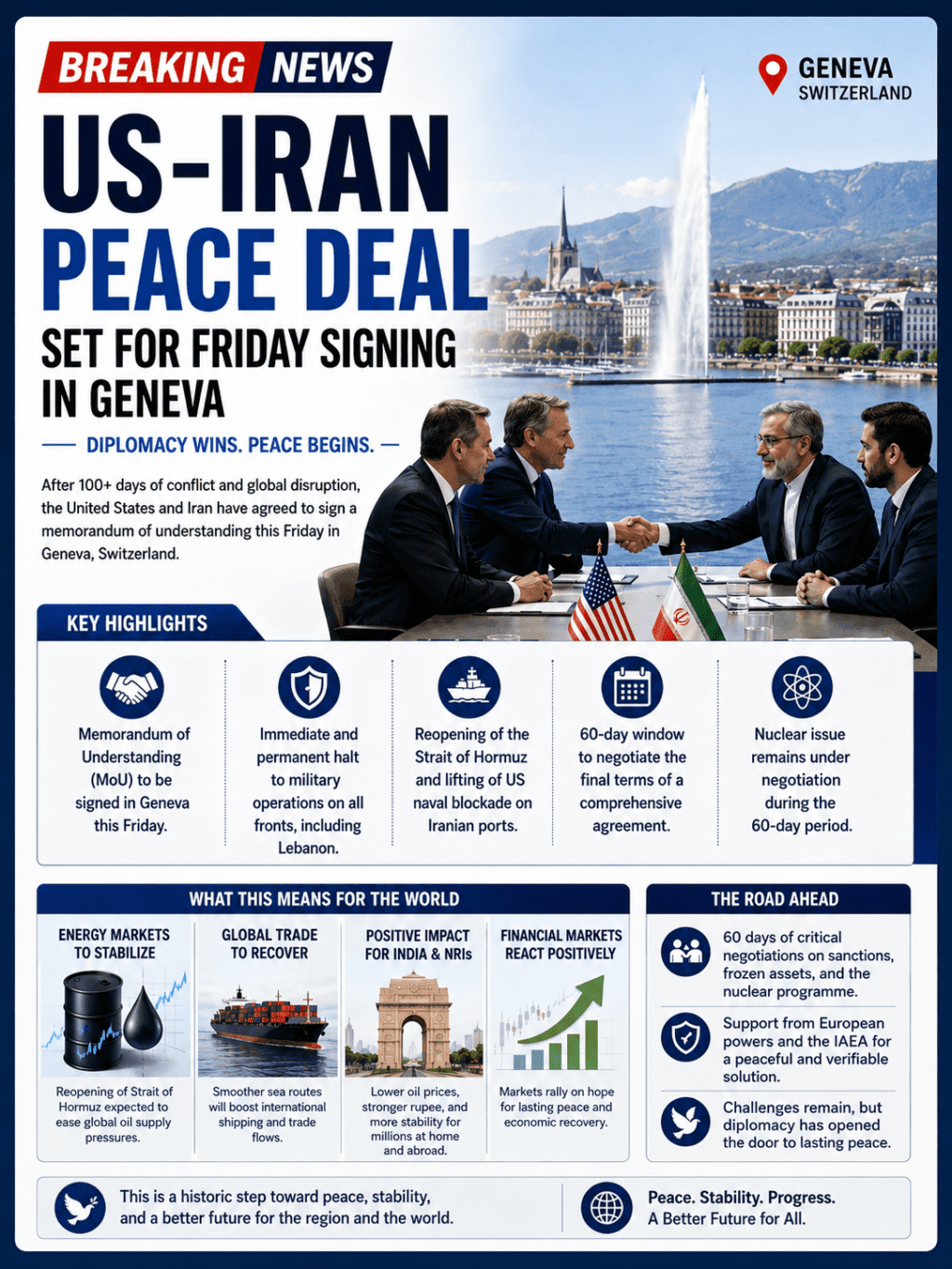
The US-Iran peace deal is on the verge of becoming reality. After more than 100 days of war that shook the global economy and disrupted energy supplies worldwide, the United States and Iran have agreed to formally sign a memorandum of understanding this Friday in Geneva, Switzerland.
US Iran Peace Deal: How It Came Together
The US Iran peace deal did not happen overnight. Months of indirect negotiations, mediated by Pakistan and Qatar, finally produced a breakthrough over the weekend. Pakistan’s Prime Minister Shehbaz Sharif was among the first to publicly confirm the agreement, calling the Friday signing ceremony in Switzerland a historic milestone. President Trump followed with a celebratory announcement, declaring the deal complete and congratulating all parties involved.
US Iran Peace Deal and the Strait of Hormuz
At the heart of the US Iran peace deal is the reopening of the Strait of Hormuz—one of the world’s most critical shipping corridors. Since the war began, the waterway had been effectively shut down, strangling global oil and gas exports from the Persian Gulf. Under the terms agreed upon, the US naval blockade on Iranian ports will be lifted, and the Strait of Hormuz is expected to be fully open to international shipping from Friday onwards.
US Iran Peace Deal: What the Agreement Covers
The US Iran peace deal is being described as an interim memorandum of understanding, not a final treaty. Key elements reportedly include an immediate and permanent halt to military operations on all fronts—including Lebanon, which has faced intensified bombardment since early March. A 60-day window will follow the signing, during which both sides will negotiate the final terms of a comprehensive agreement.
Among the major sticking points heading into those 60 days are the fate of billions of dollars in frozen Iranian assets, the lifting of long-standing international sanctions, and—most critically—the future of Iran’s nuclear program.
US Iran Peace Deal: Nuclear Question Remains Open
The nuclear issue has been the most contentious aspect of the US Iran peace deal. The two sides appear to hold differing interpretations of what was agreed. A complete resolution on enrichment levels, international inspections, and Iran’s nuclear infrastructure is expected to be hammered out during the 60-day negotiation period.
European powers, including France, Germany, Italy, and the United Kingdom, have issued statements stressing that Iran must never acquire a nuclear weapon, and have expressed willingness to work alongside the US and the International Atomic Energy Agency toward that goal.
US Iran Peace Deal: What It Means for India and NRIs
The US Iran peace deal carries significant implications for India and the global Indian community. The war had pushed oil prices sharply higher, increased the cost of everyday goods, and created deep uncertainty for NRIs living and working across Gulf nations.
With the Strait of Hormuz set to reopen, energy markets are already responding positively. Lower oil prices could ease fuel costs in India, stabilize the rupee, and reduce the financial pressure many NRI families have felt over the past several months. For Indians employed in Gulf countries, the end of hostilities also brings a welcome sense of security after a prolonged period of regional tension.
US Iran Peace Deal: Challenges Ahead
Despite the optimism surrounding the US Iran peace deal, significant hurdles remain. Israel’s position on the agreement is unclear, and questions persist about the future of Iran-backed groups across the region. Both sides have shown that ceasefires in this conflict can be fragile—armed exchanges took place as recently as last week, briefly threatening to unravel weeks of diplomatic progress.
If the 60-day negotiations fail to produce a final agreement, the situation could deteriorate once again. All eyes will be on Geneva this Friday, where the formal signing of the US Iran peace deal is expected to mark a turning point—not just for the Middle East, but for the entire world.
About The Author