NRI Remittance Tax 2026: US Senate Slashes Rate to 1% — Complete Guide for Indians in USA
3 min read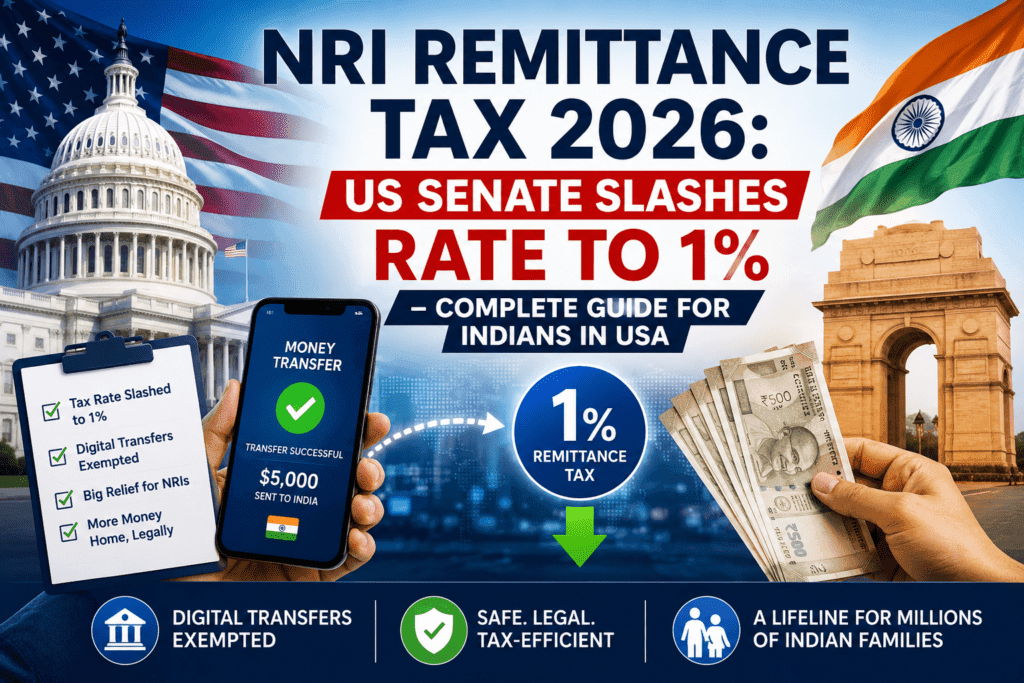
NRI remittance tax 2026 has become one of the most talked-about financial topics among Indians living in the United States — and for good reason. After months of uncertainty, the US Senate has officially slashed the proposed remittance tax to just 1%, giving millions of Indian-Americans significant relief.
What Is the NRI Remittance Tax 2026?
The NRI remittance tax 2026 is part of former President Donald Trump’s controversial “One Big Beautiful Bill Act” (OBBBA). When first introduced in the House in May 2025, the bill proposed a steep 5% tax on all international money transfers sent from the US. That would have meant a $500 charge on every $10,000 sent home — a massive burden for NRIs supporting families in India.
After strong pushback from the Indian-American community, the House version brought it down to 3.5%. The Senate has now gone further, reducing the NRI remittance tax 2026 to just 1% — and adding critical exemptions that protect most everyday NRI transfers completely.
The Most Important Thing About NRI Remittance Tax 2026
Here is what most Indians in the USA are missing about the NRI remittance tax 2026 — the biggest exemption changes everything. The 1% tax applies only to cash-based transfers made through walk-in remittance centres, money orders, or cashier’s checks.
If you send money using digital platforms or US bank accounts, you are completely exempt. This means popular apps used by Indian-Americans are fully protected from the NRI remittance tax 2026. Apps like Wise and Remitly — which route transfers through US-regulated financial institutions — are explicitly excluded under the Senate bill.
Who Does NRI Remittance Tax 2026 Actually Affect?
The NRI remittance tax 2026 in its current form targets a very specific group — non-citizens sending money through cash-based, offline channels. Most tech-savvy Indian professionals in the USA who use bank transfers, debit cards, credit cards, or digital apps will not pay this tax at all.
However, there are some NRIs who could still be impacted by the NRI remittance tax 2026. If you are on a visa, send large amounts through informal channels, or use cash-based money transfer agents, you need to be careful and shift to bank or card-based transfers immediately.
What Should Indians in USA Do Right Now?
Given the NRI remittance tax 2026 rules, here is exactly what financial advisors recommend:
First, switch all your India remittances to digital platforms immediately. Using apps like Wise or Remitly through your US bank account keeps you completely exempt from the NRI remittance tax 2026. Second, if you were planning large cash transfers for property purchases, NRE deposits, or investments in India, complete those before December 31, 2025 — the tax applies only to transfers made after that date. Third, stay updated as the bill moves toward final approval — exemptions could change in the final version.
NRI Remittance Tax 2026 — Timeline
The NRI remittance tax 2026 is expected to take effect from January 1, 2026 once the bill receives final approval. The US Senate had set a self-imposed deadline around July 4, 2025 for passing the bill. Indian-Americans should monitor news closely as the final version may bring additional changes.
India remains the world’s largest recipient of remittances,
receiving over $32 billion from the United States alone in
FY2024 — nearly 28% of India’s total remittance inflows.
For millions of Indian families back home, this money covers
daily expenses, medical bills, education fees, and home loan
payments. Any tax on these transfers directly impacts
real lives. The Senate’s decision to slash the NRI
remittance tax 2026 and exempt digital channels is
therefore not just a policy win — it is a lifeline
protected for millions of Indian families depending
on their loved ones abroad.
Bottom Line on NRI Remittance Tax 2026
For most Indians in the USA who use mainstream digital channels to send money home, the NRI remittance tax 2026 will have minimal to zero impact. The key is to stay away from cash-based transfer methods and stick to regulated digital platforms for all your India remittances going forward.
About The Author