India US Diplomat Ship Strikes Row Escalates After Indian Sailors Killed Off Oman
4 min read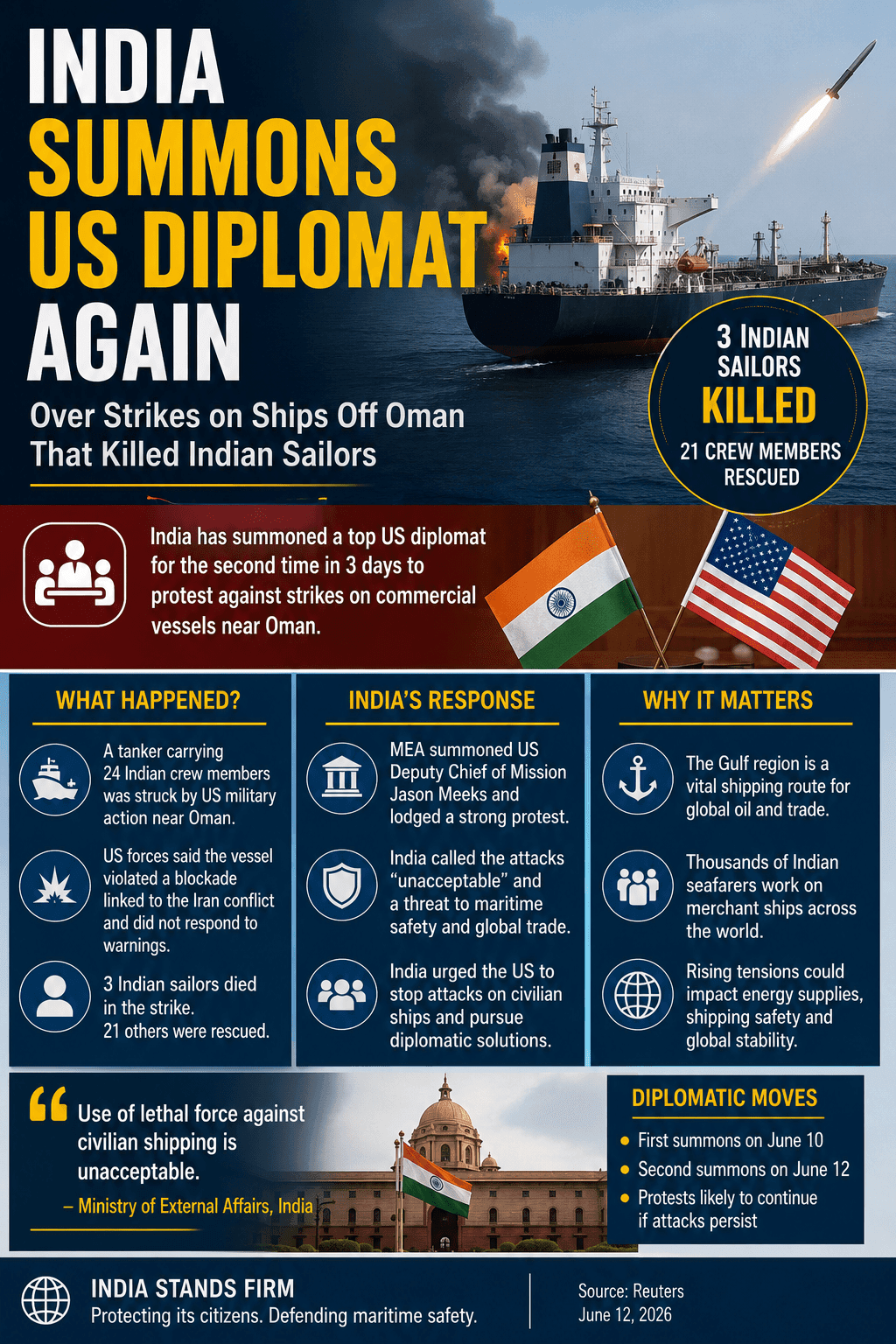
India US diplomat ship strikes have taken a serious turn this week, as New Delhi summoned a senior American envoy for the second time in just three days following a string of military strikes on commercial vessels off the coast of Oman. The unusual diplomatic move comes after three Indian sailors lost their lives and dozens more were caught in the crossfire of an escalating maritime conflict tied to the broader US-Iran standoff.
The India US diplomat strike controversy began earlier in the week when a US Navy operation targeted the Palau-flagged oil tanker MT Settebello in the Gulf of Oman. Of the 24 Indian crew members aboard, three were killed and the rest were rescued. American forces claimed the vessel had been attempting to ferry Iranian oil in violation of an active blockade and said precision munitions were fired into the ship’s engine room after the crew failed to comply with repeated warnings.
Second Strike Deepens India US Diplomat Ship Strikes Crisis
Just two days later, the India US diplomat ship strikes situation worsened further when another vessel, the Guinea-Bissau-flagged tanker MT Jalveer, came under attack in the same waters. This time, 20 to 22 Indian crew members were on board. Fortunately, all of them were evacuated safely, with no deaths or injuries reported. The Indian Embassy in Muscat confirmed that the rescue operation was carried out with support from the Royal Navy of Oman, and that the crew reached shore safely at Shinas port.
It was this second attack that pushed India’s Ministry of External Affairs to call in the US Chargé d’Affaires for a fresh round of protest, marking the second such summons within 72 hours. The India US diplomat ship strikes episode is being viewed as a rare moment of friction between two countries that have otherwise built a close strategic partnership over the past two decades.
Why the India US Diplomat Ship Strikes Issue Matters for New Delhi
For India, the India US diplomat ship strikes dispute isn’t just about diplomatic optics, it’s about the safety of thousands of Indian seafarers who routinely transit the Strait of Hormuz and the Gulf of Oman as part of global shipping operations. Indian nationals make up a significant share of crew members on commercial vessels worldwide, and any escalation in this corridor directly puts their lives at risk.
During the latest summons, India’s Additional Secretary for the Americas Division conveyed New Delhi’s concerns directly to the US envoy regarding the safety and security of Indian nationals working aboard ships in the region. The message was clear: India expects greater caution from US forces operating near commercial shipping lanes, especially when Indian crew members are involved.
Diplomatic Pressure Builds Amid Wider Regional Tensions
The India US diplomat ship strikes standoff is unfolding against the backdrop of a tense military confrontation between the United States and Iran, with American forces reportedly enforcing a blockade aimed at stopping Iranian oil exports through the region. Commercial vessels suspected of carrying Iranian crude have increasingly become targets, raising fresh concerns among countries like India whose nationals form a large part of the global maritime workforce.
This isn’t the first time India has had to navigate turbulence in Gulf waters involving foreign naval forces. New Delhi has previously sought investigations and protested incidents involving Indian sailors and fishermen caught in conflict zones near the UAE and other Gulf states. However, the India US diplomat ship strikes situation stands out because of how quickly it escalated, two summons in three days is a notably swift diplomatic response, especially involving Washington.
What Could Happen Next in the India US Diplomat Ship Strikes Standoff
With tensions still simmering, the India US diplomat ship strikes matter is likely to remain a key talking point in India-US relations in the days ahead. New Delhi will be watching closely to see whether Washington adjusts its rules of engagement near commercial shipping lanes, particularly given the volume of Indian crew members working on vessels passing through the Strait of Hormuz.
For NRI families and the broader Indian diaspora connected to the shipping and maritime industry, this developing story carries real personal stakes. Many Indian seafarers send remittances home and support families across India while working aboard international vessels, making safety in conflict-prone waters a matter that touches everyday households far beyond diplomatic corridors.
As this episode continues to develop, India’s government has signaled it will keep pressing Washington for accountability and stronger safeguards. Whether this leads to any tangible policy shift from the US side remains to be seen, but for now, the diplomatic temperature between the two nations remains noticeably elevated over an issue that has already cost Indian lives at sea.
About The Author