India EV Manufacturing Boost: Government and Industry Accelerate Production Plans in 2026
3 min read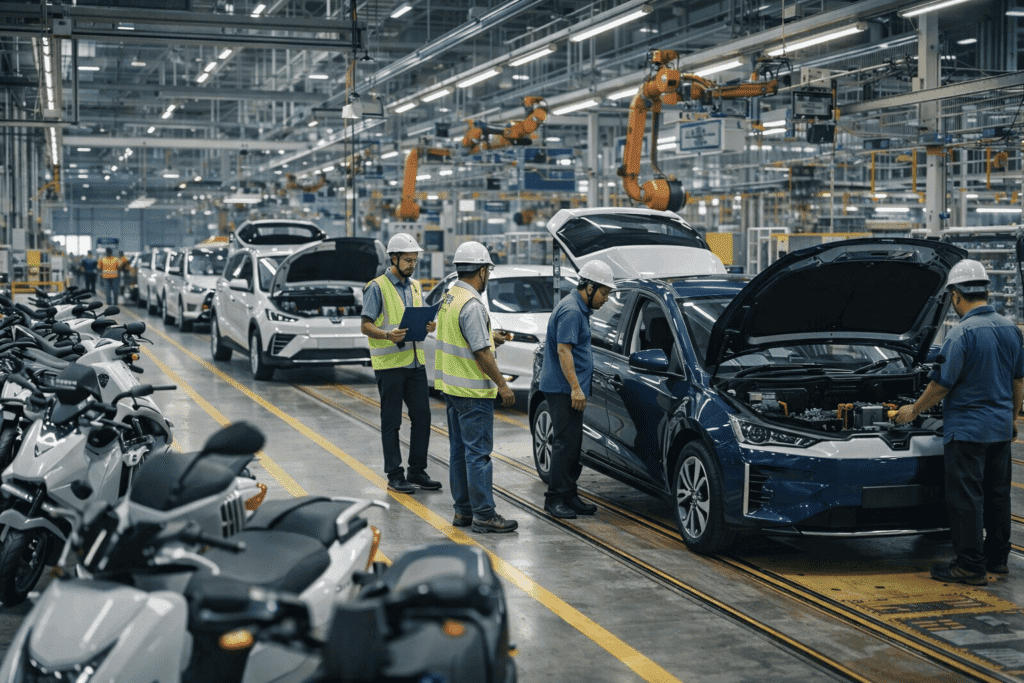
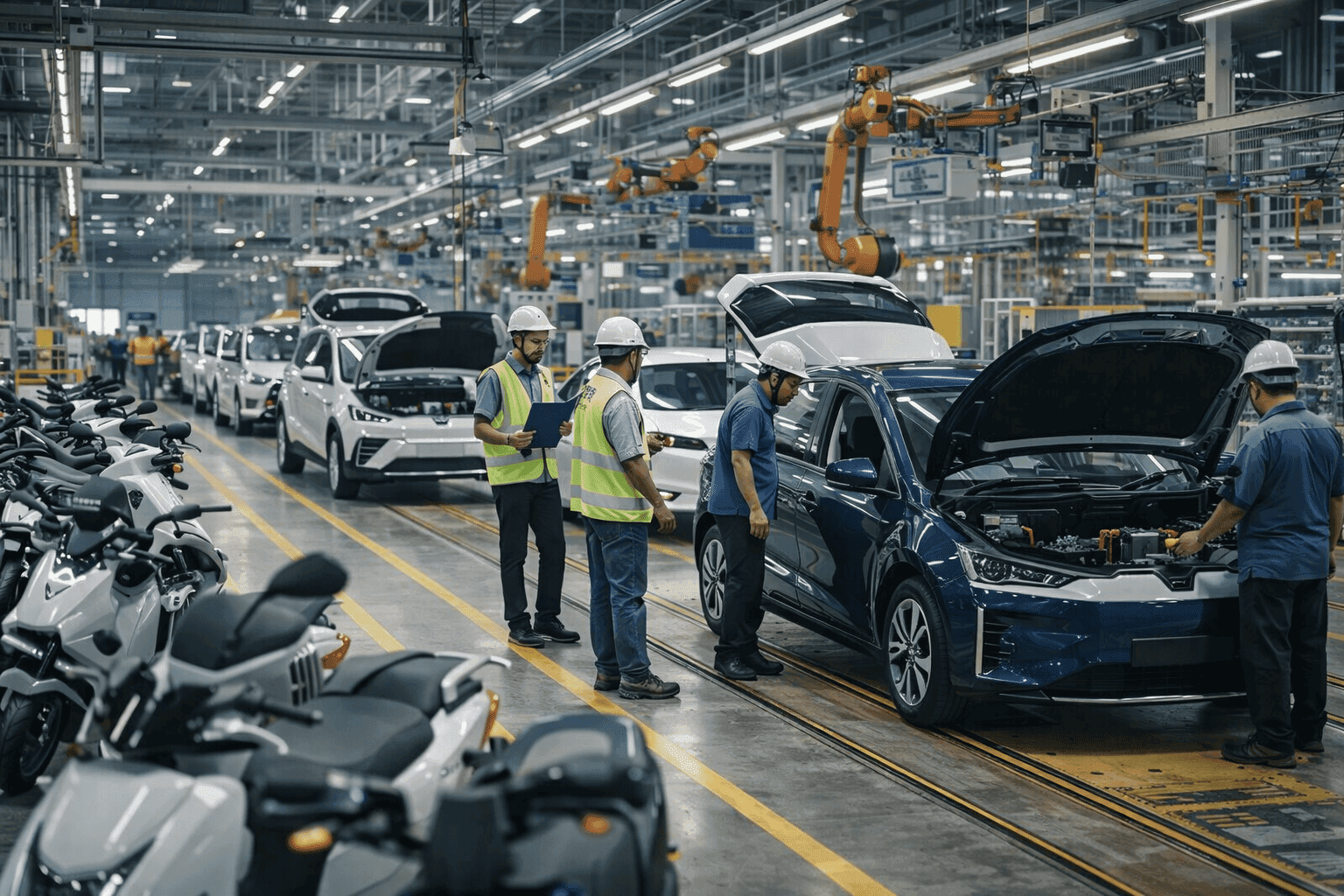
India EV Manufacturing Boost 2026 is gaining significant traction as leading automobile manufacturers and component makers announce expanded production plans, driven by strong policy support, rising domestic demand, and global investment interest. This development signals a pivotal shift in India’s auto industry as it positions itself as an EV production hub in Asia.
India’s EV sector has seen robust growth over the past few years, but 2026 is shaping up as a year of strategic scaling of manufacturing capacity. Recent corporate announcements indicate plans to bring multiple new electric vehicle assembly lines online, expand battery production, and strengthen the supply chain for critical components.
Major Investments and New Production Plans
Several automakers have publicly confirmed new investments:
- A leading Indian OEM (Original Equipment Manufacturer) has announced plans to double its electric two-wheeler production capacity by mid-2026, facilitated by a new manufacturing facility in Tamil Nadu.
- A global EV maker has confirmed an expansion of its planned production plant near Gujarat, with a projected output of over 150,000 units annually.
- Battery manufacturers are accelerating plans to set up gigafactories in Maharashtra and Kheda (Gujarat), focusing on lithium-ion cells and advanced battery technologies.
These developments follow recent policy signals from the government aimed at encouraging domestic manufacturing and reducing reliance on imported parts.
Government Policy Support
The Ministry of Heavy Industries and Transport has reiterated support for EV manufacturing through incentive schemes, including the Faster Adoption and Manufacturing of Electric Vehicles (FAME) program. Officials have confirmed that the government is evaluating enhancements to the existing framework to make production incentives more industry-friendly. Proposed changes include:
- Additional support for localisation of battery supply chains
- Performance-linked incentives for EV OEMs
- Subsidies targeted at reducing manufacturing costs
This proactive policy environment has boosted investor confidence and encouraged multinational companies to scale operations.
Charging Infrastructure and Industrial Hubs
Alongside manufacturing capacity expansion, infrastructure development is progressing. New public-private partnerships are being launched to install fast-charging stations across national corridors and major urban clusters. Industry experts say that improved charging logistics will amplify the effects of the India EV Manufacturing Boost 2026 by making EV usage more accessible for consumers.
Public charging growth has been concentrated in cities so far, but officials emphasize the need to expand into tier-2 and tier-3 towns to sustain long-term EV adoption.
Supply Chain and Component Ecosystem
Critical to this manufacturing boom is the expansion of the EV component ecosystem. More than a dozen Tier-1 suppliers have announced investment plans to produce high-voltage cables, power electronics, battery management systems, and electric motors in India. These suppliers are positioning themselves to serve both domestic OEMs and export markets in Southeast Asia and the Middle East.
The presence of a robust component ecosystem also strengthens India’s ambitions for export-oriented EV production.
Industry Response
Automakers and industry bodies have largely welcomed the recent announcements. They emphasize that sustained policy clarity, talent development, and infrastructure investment are critical for sustaining growth beyond 2026.
One industry executive noted that expanded EV manufacturing would generate thousands of direct and indirect jobs in assembly lines, battery plants, and charging infrastructure deployment.
Challenges Ahead
Despite the positive momentum, challenges remain. Automakers warn that supply chain bottlenecks for critical raw materials, especially for battery production, could slow growth. There are also concerns about ensuring affordable financing for EV buyers and promoting consumer confidence.
Industry stakeholders are urging the government to further simplify tax structures and trade regulations to make India more competitive on the global EV manufacturing map.
Economic & Environmental Impact
The India EV Manufacturing Boost 2026 is expected to have broad economic benefits, including heightened industrial activity, job creation, and export potential. Moreover, increased EV production aligns with national environmental goals, as the country continues to work to reduce vehicular emissions and improve air quality.
Conclusion
With major production plans unfolding, policy measures evolving, and infrastructure improving, India EV Manufacturing Boost 2026 represents a significant inflection point for the country’s automobile sector. Stakeholders agree that 2026 could be the year India cements its role as a regional EV manufacturing powerhouse.
About The Author