Trump Iran Deal: President Signs 14-Point Pact to End War, Faces Fierce GOP Backlash
4 min read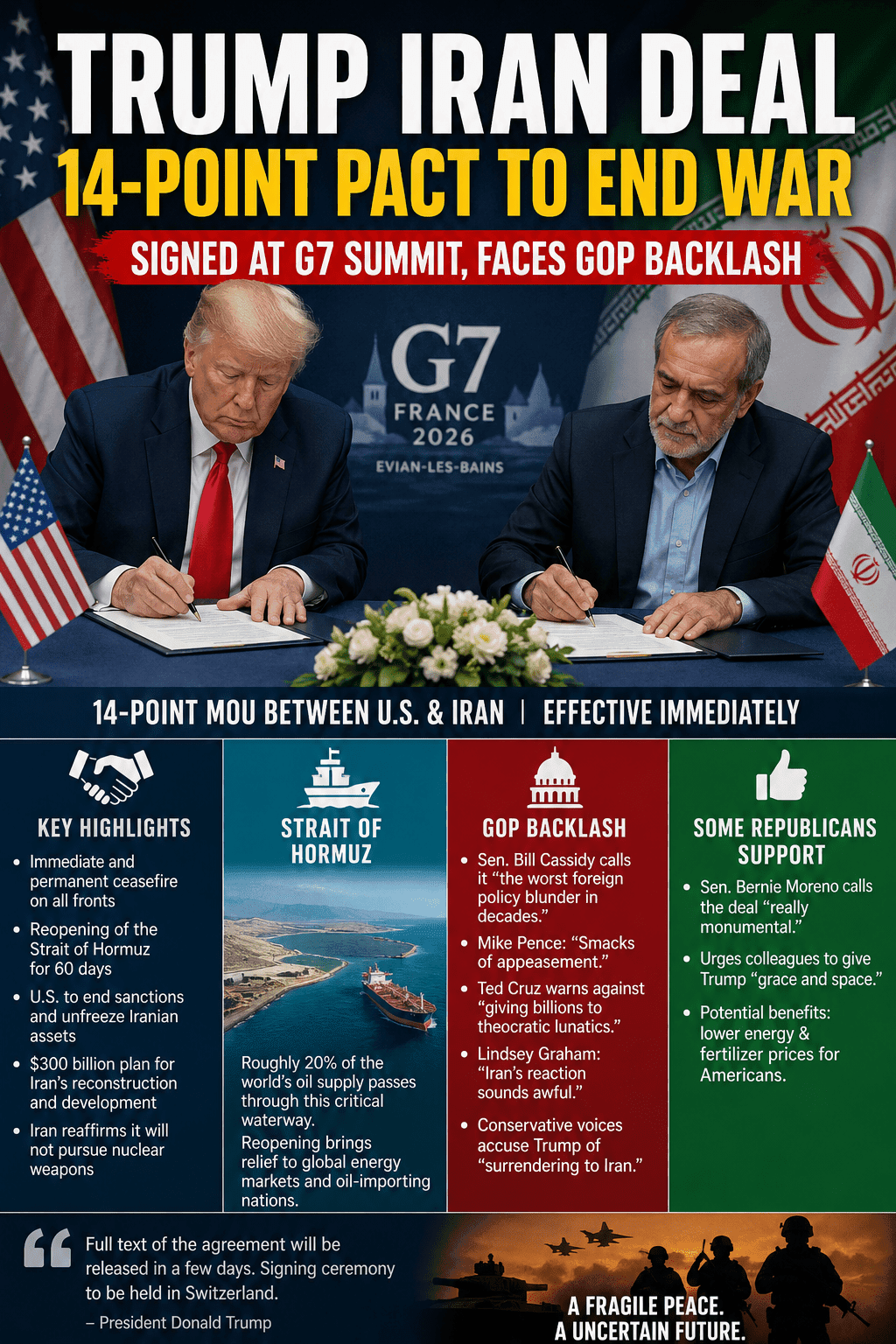
President Donald Trump and Iranian President Masoud Pezeshkian have formally signed a 14-point memorandum of understanding (MOU) aimed at bringing a permanent end to the four-month-long war between the United States and Iran. The Trump Iran deal was signed on Wednesday at the Palace of Versailles in France, on the sidelines of the G7 summit, and immediately came into effect.
The agreement marks one of the most significant diplomatic breakthroughs of Trump’s second term, but it has also triggered an intense wave of criticism from within his own party, with several senior Republicans calling it a dangerous capitulation to Tehran.
What the Trump Iran Deal Actually Says
According to officials familiar with the document, titled the “Islamabad Memorandum of Understanding between the United States of America and the Islamic Republic of Iran,” the Trump Iran deal lays out an immediate and permanent cessation of military operations on all fronts, including in Lebanon. The pact also commits both nations to a 60-day negotiating window aimed at finalizing a comprehensive settlement.
One of the central provisions of the Trump Iran deal involves the reopening of the Strait of Hormuz, the critical oil shipping corridor that has been effectively shut since late February. Under the terms, Iran has agreed to allow safe, free passage of commercial vessels through the strait for an initial 60-day period, after which Tehran will begin negotiations with Oman over the long-term administration of the waterway. In exchange, Washington has agreed to begin dismantling its naval blockade of Iranian ports.
The Trump Iran deal also includes major economic concessions from the United States. Washington has pledged to terminate existing sanctions on Iran and make previously frozen Iranian funds and assets fully available for use. Additionally, the U.S. has committed to working with regional partners to develop a plan involving at least $300 billion for the reconstruction and economic development of Iran, a provision that has become the single most controversial element of the entire agreement.
On the nuclear front, the Trump Iran deal states that Iran has reaffirmed it will not pursue or develop nuclear weapons, with a mechanism still to be negotiated regarding the fate of its existing enriched uranium stockpile under International Atomic Energy Agency oversight. A senior U.S. official described Iran’s commitment toward eventually dismantling its enriched stockpile as a major win for Washington, though the most contentious nuclear details have been deferred to the 60-day negotiating period.
Republican Backlash Mounts Against the Agreement
While G7 leaders at the summit in Evian-les-Bains quickly threw their support behind the agreement, the reaction from Trump’s own party in Washington has been far less unified. The Trump Iran deal is facing what several reports describe as a cascade of criticism from senior Republican lawmakers and conservative commentators.
Louisiana Senator Bill Cassidy delivered one of the sharpest rebukes, calling the agreement “the worst foreign policy blunder in decades” and arguing that it leaves Iran stronger while weakening America’s allies. Former Vice President Mike Pence said the deal “does smack of the kind of appeasement” associated with the Obama-era Iran nuclear agreement that Trump withdrew from during his first term. Texas Senator Ted Cruz expressed deep unease over the $300 billion reconstruction provision, warning that “giving billions of dollars to theocratic lunatics” carries serious risks, while Senator Lindsey Graham said descriptions of the deal coming from Iran “sound awful” and warned it could mirror the 2015 nuclear agreement if enrichment restrictions aren’t airtight.
Conservative commentator Erick Erickson was even more blunt, declaring flatly that “Trump has surrendered to Iran.” Meanwhile, several Trump administration cabinet officials have reportedly voiced internal doubts about Tehran’s sincerity in honoring the terms of the Trump Iran deal.
Not all Republicans have come out against the agreement. Ohio Senator Bernie Moreno offered a strong endorsement, calling the deal “really monumental” and urging colleagues to give the president “grace and space,” while pointing to potential benefits like lower energy and fertilizer prices for American consumers as sanctions on Iranian oil ease.
Why the Strait of Hormuz Matters
The Strait of Hormuz has been a flashpoint throughout the conflict, with roughly 20 percent of the world’s oil supply historically passing through the narrow waterway before the war forced its closure. The reopening promised under the Trump Iran deal is being closely watched by global markets and energy-dependent nations, including India, where Prime Minister Narendra Modi raised concerns directly with Trump at the G7 summit about the safety of Indian seafarers working in the strait.
Trump has said the full text of the agreement would be released publicly within days, with a formal signing ceremony set to take place in Switzerland. For now, the Trump Iran deal remains a fragile, interim arrangement, one that has ended active hostilities but left the toughest questions about Iran’s nuclear future unresolved.
About The Author