G7 Summit Iran Deal Wins Backing From World Leaders in France
4 min read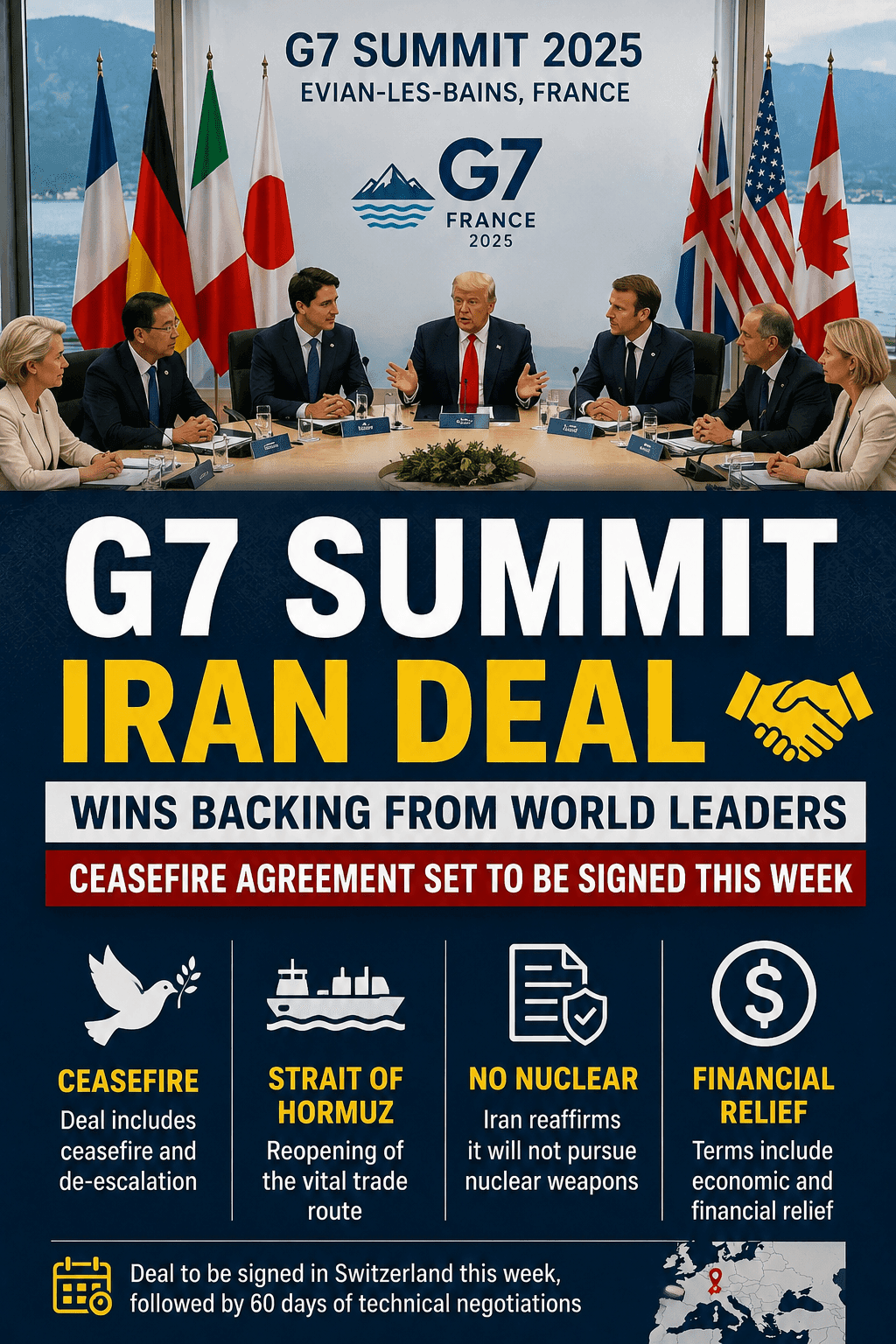
World leaders meeting at the G7 summit have thrown their support behind the emerging G7 summit Iran deal, signaling international backing for an agreement aimed at ending the recent conflict between the United States, Israel, and Iran. The development came on the final day of the summit, held in Evian-les-Bains, France, where the Iran agreement dominated discussions alongside ongoing concerns about Russia and Ukraine.
What the G7 Summit Iran Deal Includes
According to a joint statement released by G7 leaders, the group welcomed the memorandum of understanding reached between the United States and Iran, describing it as a step toward preventing Iran from acquiring nuclear weapons while addressing concerns tied to its regional and ballistic missile activities. The G7 summit Iran deal also places significant emphasis on reopening the Strait of Hormuz, a critical global trade route, with leaders calling for it to operate without restrictions or tolls.
The statement was notable in part because the United States itself signed on to the joint language, a detail that underscored the seriousness with which Washington and its allies are treating the agreement. Leaders from Canada, France, Germany, Italy, Japan, the United Kingdom, and the United States all backed the language, pledging both support and a willingness to contribute to the deal’s implementation going forward.
A draft copy of the broader agreement, obtained by international media, outlines several key provisions tied to the G7 summit Iran deal. These include terms for a ceasefire, the reopening of the Strait of Hormuz, a degree of financial relief for Iran, and a renewed commitment from Tehran that it will not pursue nuclear weapons development. Once formally signed, the agreement is expected to trigger a 60-day window during which both sides will negotiate more detailed technical terms for a lasting resolution.
Where and When the Deal Will Be Signed
While the G7 summit Iran deal has secured broad international backing, key details remain unresolved. The United States has not yet released the full text of the agreement publicly, though officials have indicated it could be shared as early as this week. The formal signing is expected to take place at a resort in Switzerland, with multiple reports pointing to a Friday signing date.
Despite the optimism expressed at the summit, questions remain about how smoothly the reopening of the Strait of Hormuz will actually unfold in practice, and what enforcement mechanisms will be attached to the broader G7 summit Iran deal. The lack of full transparency around the agreement’s specific terms has drawn some criticism, with calls growing for the complete text to be made public before the signing takes place.
Trump’s Comments on the Agreement
Speaking at the summit, the US President addressed the G7 summit Iran deal directly, clarifying that it should not be viewed as a final or permanent resolution. He stated that the United States would resume military strikes against Iran if the country failed to comply with the terms of the agreement going forward. He also pushed back on reports suggesting that the US would contribute to a $300 billion reconstruction fund for Iran as part of the deal, denying that any such financial commitment had been made or requested from Gulf nations.
These remarks reflect the broader tone of cautious optimism that characterized discussions at the G7 summit. While the G7 summit Iran deal has received public support from key allies, leaders have stopped short of describing it as a guaranteed long-term solution, instead framing it as an important but conditional step toward regional stability.
Lebanon and the Wider Regional Picture
Beyond the core elements of the G7 summit Iran deal, the joint statement issued by leaders also addressed the situation in Lebanon, where Israeli forces have continued targeting sites linked to Hezbollah, the Iran-backed militant group. The G7 leaders called for an immediate and robust ceasefire in Lebanon, while reaffirming support for the country’s territorial integrity and sovereignty. The statement also reiterated ongoing international efforts aimed at disarming Hezbollah as part of a broader regional stabilization push tied to the G7 summit Iran deal.
This regional dimension highlights how closely intertwined the Iran agreement is with other ongoing conflicts in the Middle East, with G7 leaders signaling that lasting peace will likely require coordinated diplomatic efforts across multiple fronts rather than a single isolated agreement.
Russia and Ukraine Also on the Agenda
Although the G7 summit Iran deal was the dominant topic of discussion, leaders also used the summit to address the ongoing war between Russia and Ukraine. According to reports from the summit, G7 nations agreed to increase pressure on Russia, with renewed pledges of support for Ukraine’s position in the conflict. The US President held separate discussions with Ukraine’s leader during the summit and indicated plans for further talks in the near future, while also referencing a recent conversation with Russia’s president.
This broader diplomatic engagement illustrates how the G7 summit Iran deal fits into a wider pattern of global crisis management currently facing world leaders, with overlapping conflicts in the Middle East and Eastern Europe both demanding sustained international attention.
What Happens Next
With the G7 summit Iran deal now backed by all member nations, attention turns to the coming days, when the formal signing in Switzerland is expected to take place. The 60-day negotiation window that follows will be closely watched, as it is expected to determine many of the more technical and enforceable aspects of the agreement that remain undefined for now.
For now, the G7 summit Iran deal represents a significant diplomatic milestone, even as uncertainty lingers over its long-term durability and the practical challenges of implementation across a region still grappling with multiple overlapping conflicts.
About The Author