SoftBank OpenAI Cybersecurity Service Launched to Protect Japan’s Critical Infrastructure
4 min read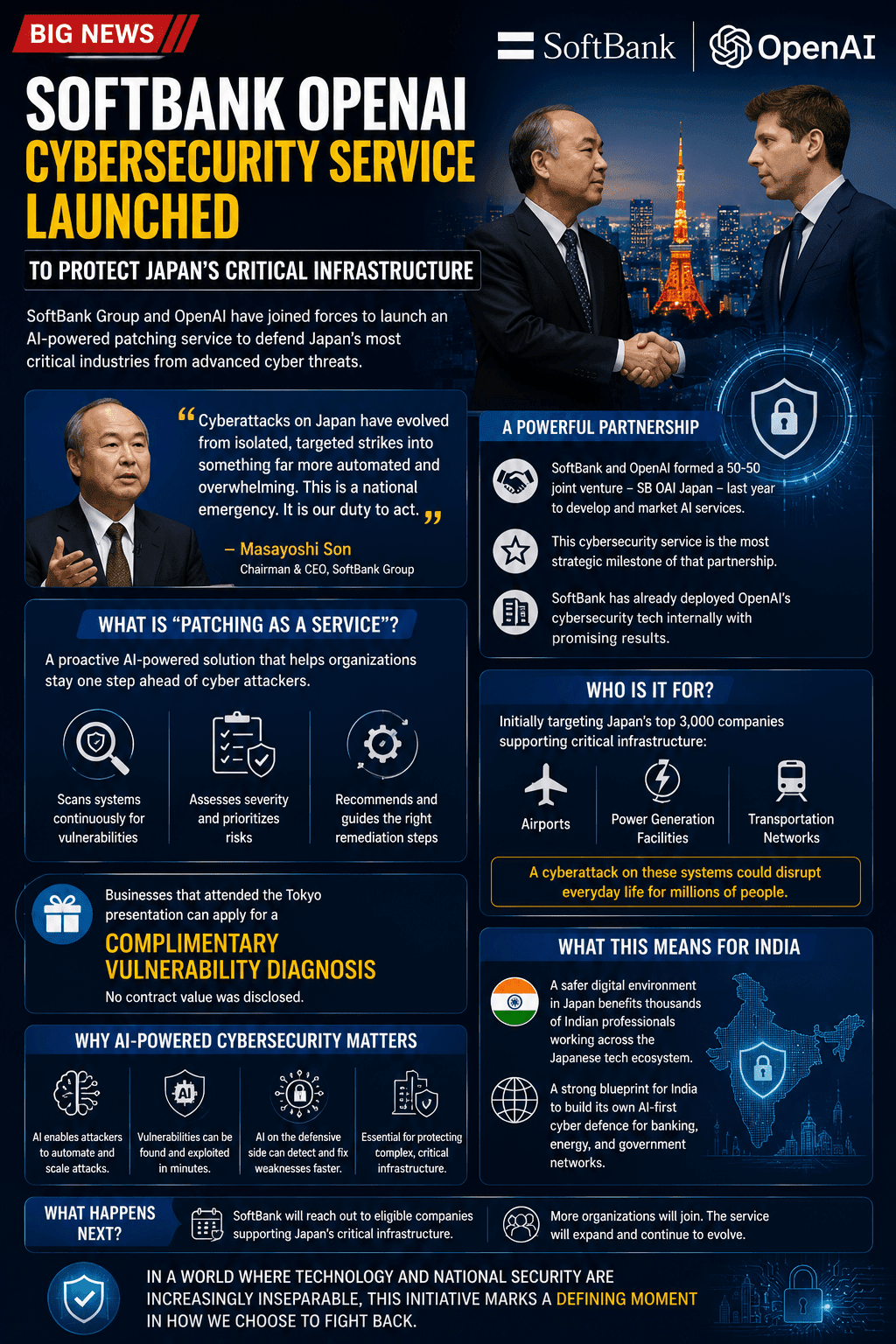
The SoftBank OpenAI cybersecurity partnership has taken a major leap forward. Japan’s technology giant SoftBank Group has officially launched an artificial intelligence-powered patching service built alongside OpenAI, unveiled at a landmark event in Tokyo on Tuesday. The initiative is designed to shield the country’s most critical industries from a rapidly escalating wave of AI-driven digital attacks.
SoftBank OpenAI Cybersecurity: A Crisis That Demands Action
SoftBank’s chairman and chief executive Masayoshi Son used strong language when addressing the scale of the threat Japan currently faces. He described the country’s exposure to modern cyberattacks as a national emergency, explaining how digital warfare has evolved from isolated, targeted strikes into something far more automated and overwhelming. As Son made clear, the SoftBank OpenAI cybersecurity initiative is not just a business decision—it is a matter of national duty.
What the Patching Service Actually Does
The new offering, formally called “Patching as a Service,” sits at the core of the SoftBank OpenAI cybersecurity program. Rather than waiting for a breach to occur, the service takes a proactive stance—scanning organizational systems for weaknesses, assessing how severe those vulnerabilities are, and recommending the right remediation steps before attackers can exploit them.
The service will initially target Japan’s top 3,000 companies operating behind the country’s most essential infrastructure — airports, power generation facilities, and transportation networks. These are systems where a successful cyberattack could cause not just financial damage, but direct disruption to everyday civilian life.
Businesses that attended Tuesday’s Tokyo presentation were offered the opportunity to apply for a complimentary vulnerability diagnosis, giving organizations an immediate and cost-free entry point into the SoftBank OpenAI cybersecurity program. No overall contract value between the two companies was publicly disclosed.
A Partnership Built on Shared Vision
Tuesday’s announcement builds on an already established collaboration. SoftBank and OpenAI formed a 50-50 joint venture last year—named SB OAI Japan—specifically to develop and market AI services for the Japanese market. The SoftBank OpenAI cybersecurity launch represents the most strategically significant milestone of that partnership to date, moving into one of the most sensitive areas of modern enterprise: digital defence.
Before rolling the service out commercially, SoftBank had already deployed OpenAI’s cybersecurity technologies internally across its own systems. The large-scale vulnerability assessment produced promising results, and the operational experience gained from that exercise is now being directly applied to what customers will receive through the SoftBank OpenAI cybersecurity service.
Why AI-Powered Cybersecurity Matters Right Now
The timing of this launch is no coincidence. As artificial intelligence tools grow more accessible globally, malicious actors are increasingly using them to automate attacks at a scale and speed that traditional security systems cannot keep up with. Vulnerabilities that once took skilled hackers days to identify can now be discovered and exploited within minutes.
This is precisely the gap the SoftBank OpenAI cybersecurity service is built to close — using advanced AI on the defensive side to match and outpace what attackers are deploying offensively. For large organizations managing complex infrastructure, the ability to continuously and automatically identify weaknesses before they are weaponized is no longer a luxury—it is a necessity.
What This Means for India and the NRI Tech Community
The SoftBank OpenAI cybersecurity development carries direct relevance for the global Indian technology community. Thousands of Indian IT professionals are embedded across Japan’s technology sector and within multinational firms managing critical infrastructure throughout Asia. A stronger cybersecurity environment in Japan means a safer working ecosystem for many of them.
Beyond that, the SoftBank-OpenAI model offers a potential blueprint for India’s own approach to AI-enabled cyber threats. India’s banking systems, energy grids, and government networks face growing digital risks, and initiatives of this scale demonstrate what a serious, AI-first defense strategy can look like.
What Happens Next
SoftBank has confirmed it will progressively reach out to eligible companies supporting Japan’s critical infrastructure, inviting them to sign up for vulnerability assessments under the SoftBank OpenAI cybersecurity program. The rollout is expected to expand steadily as more organizations join and the service continues to mature.
In a world where technology and national security are becoming increasingly inseparable, this initiative marks a defining moment in how nations and corporations choose to fight back.
About The Author