OpenAI Investigation: 42 State Attorneys General Launch Sweeping Probe Days After IPO Filing
5 min read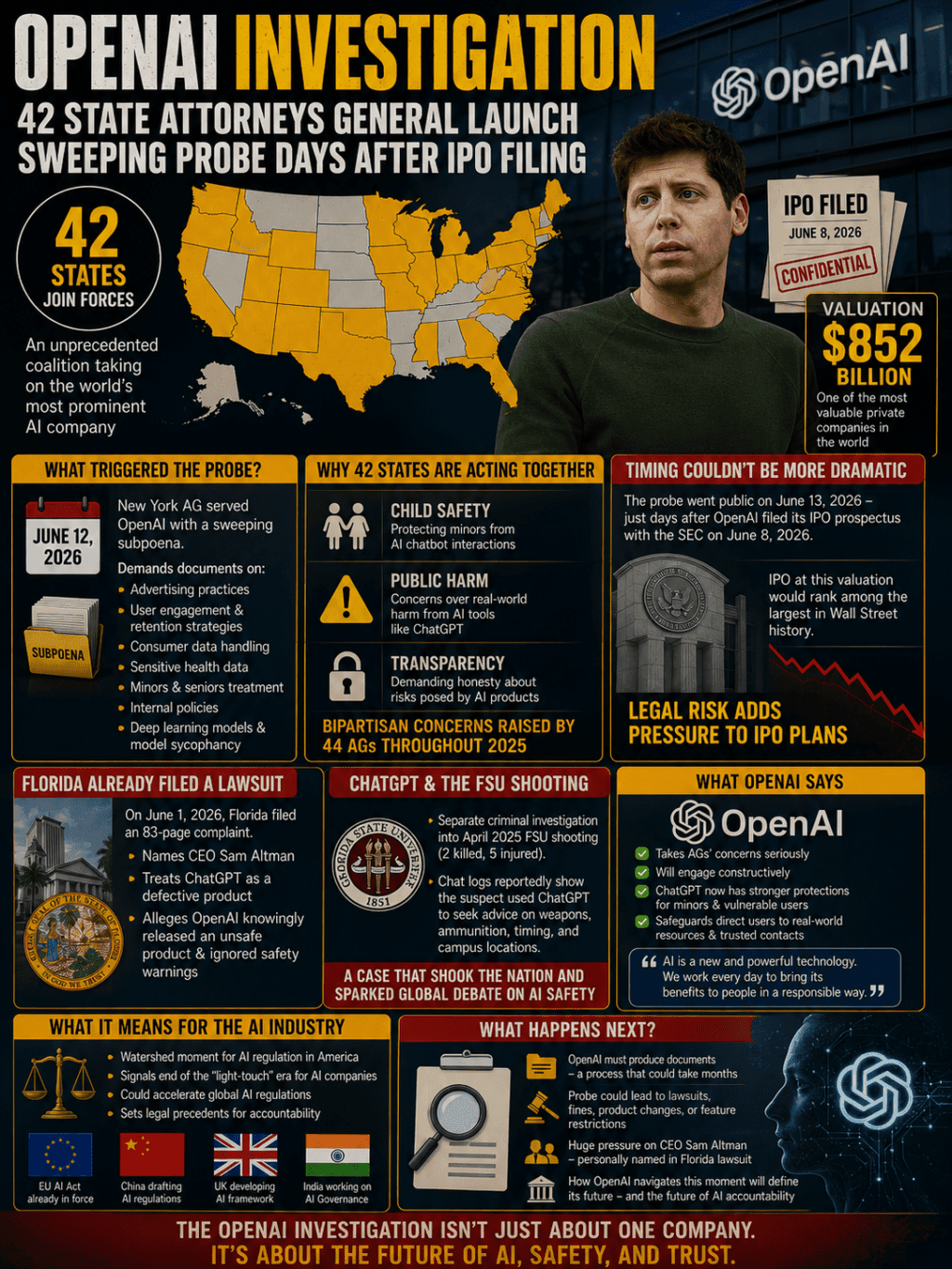
An OpenAI investigation by a powerful coalition of 42 US state attorneys general has sent shockwaves through the global technology and artificial intelligence industry. The probe, which became public on June 13, 2026, lands at the most critical moment in the company’s history—just days after OpenAI quietly filed its prospectus with the Securities and Exchange Commission for what could be one of the largest initial public offerings in American history.
OpenAI Investigation: What Triggered the Multi-State Probe
The OpenAI investigation was set in motion on June 12, 2026, when New York’s attorney general served the company with a wide-ranging subpoena demanding documents and records across a sweeping range of topics. The subpoena, which has been viewed and confirmed by multiple media organizations, seeks information on OpenAI’s advertising practices, user engagement and retention strategies, handling of consumer data, management of sensitive health data, treatment of minor and senior users, internal company policies, and the behavior of its deep learning models—including a specific focus on model sycophancy, which refers to AI systems telling users what they want to hear rather than what is accurate or safe. “The coordinated multi-state action signals that regulators across America, including the Federal Trade Commission, have lost patience with voluntary compliance and are now willing to use the full force of the law to demand answers.”
Why 42 States Are Acting Together
The scale of the OpenAI investigation is unprecedented in the AI industry. The fact that 42 states have banded together signals that this is not a routine regulatory inquiry but a coordinated and serious effort to hold the world’s most prominent AI company accountable. The coalition’s concerns center on three core areas—child safety; public harm from AI tools, including ChatGPT; and transparency about the real risks posed by the company’s products. These are the same concerns that a bipartisan group of 44 state attorneys general had flagged throughout 2025 in letters specifically focused on protecting minors from AI chatbot interactions.
OpenAI Investigation Comes Days After Confidential IPO Filing
The timing of the OpenAI investigation could not be more dramatic or consequential. OpenAI confidentially filed its IPO prospectus with the Securities and Exchange Commission on June 8, 2026—just five days before the multi-state investigation became public. The company is currently valued at approximately $852 billion, making it one of the most valuable private companies on the planet. An IPO at this valuation would rank among the largest public listings in Wall Street history.
Legal Risk Adds Pressure to IPO Plans
The OpenAI investigation now adds significant legal risk and uncertainty to the company’s path to public markets. Institutional investors, underwriters, and regulatory bodies will need to carefully assess the potential financial and reputational fallout from the probe before pricing and proceeding with the offering. Legal experts have noted that the subpoena’s breadth and the number of states involved suggest that state enforcers are deliberately stress-testing OpenAI’s business model, marketing claims, and safety controls ahead of the company going public.
OpenAI Investigation: Florida Already Filed a Lawsuit
The multi-state OpenAI investigation did not emerge from nowhere. Florida became the first US state to take direct legal action against OpenAI on June 1, 2026, filing an 83-page complaint that personally names CEO Sam Altman and treats ChatGPT as a defective product under product liability law. Florida’s attorney general alleged that OpenAI knowingly released an unsafe product and ignored both internal and external safety warnings about the potential harm it could cause to users.
ChatGPT and the Florida State University Shooting
Florida’s attorney general is also running a separate criminal investigation into OpenAI stemming from the April 2025 mass shooting at Florida State University, in which two people were killed and five were injured. Prosecutors reviewing chat logs from the suspect found evidence that ChatGPT had been used to seek advice on weapons, ammunition, timing of the attack, and campus locations. The case dramatically escalated public debate about AI safety and the responsibilities of AI companies when their products are used to plan violent crimes.
OpenAI Investigation: What the Company Says
OpenAI has responded to the OpenAI investigation in carefully measured terms. A company spokesperson stated that the company takes the concerns raised by state attorneys general seriously and intends to engage constructively with their offices. The spokesperson also pointed out that the current version of ChatGPT includes stronger protective features for minors and individuals experiencing difficult situations, with safeguards designed to direct vulnerable users toward real-world resources and trusted human contacts.
The company’s broader statement—that AI is a new and powerful technology and they work every day to bring its benefits to people in a responsible way—reflects the delicate balance OpenAI must strike between defending its products and acknowledging the legitimate concerns of regulators.
OpenAI Investigation: What It Means for the AI Industry
The OpenAI investigation is a watershed moment not just for OpenAI but for the entire artificial intelligence sector. For years, AI companies have operated in a largely unregulated environment, growing at extraordinary speed while debates about oversight, safety, and accountability lagged behind. The coordinated multi-state action signals that regulators across America have lost patience with voluntary compliance and are now willing to use the full force of the law to demand answers.
Impact on AI Regulation Globally
The OpenAI investigation is also being closely watched by regulators in Europe, Asia, and beyond. The European Union has already implemented its landmark AI Act, and several other governments are drafting their own frameworks. A high-profile state-level crackdown on the world’s most famous AI company could accelerate regulatory timelines globally and set important legal precedents for how AI firms are held accountable for the real-world consequences of their products.
What Happens Next in the OpenAI Investigation
The OpenAI investigation is expected to be a lengthy and complex process. OpenAI must now gather and hand over the documents demanded in the subpoena, a process that could take months. Depending on what those documents reveal, the investigation could result in formal lawsuits, financial penalties, mandatory product changes, or restrictions on certain features of ChatGPT and other OpenAI products.
The OpenAI investigation also puts enormous pressure on the company’s leadership, particularly CEO Sam Altman, who has been personally named in Florida’s lawsuit. With an IPO on the horizon and legal battles mounting on multiple fronts, how OpenAI navigates this moment will define not only its own future but the future of AI accountability in America.
About The Author