US Federal Court Strikes Down Trump’s $100,000 H-1B Visa Fee — Big Relief for Indian Workers and NRIs
4 min read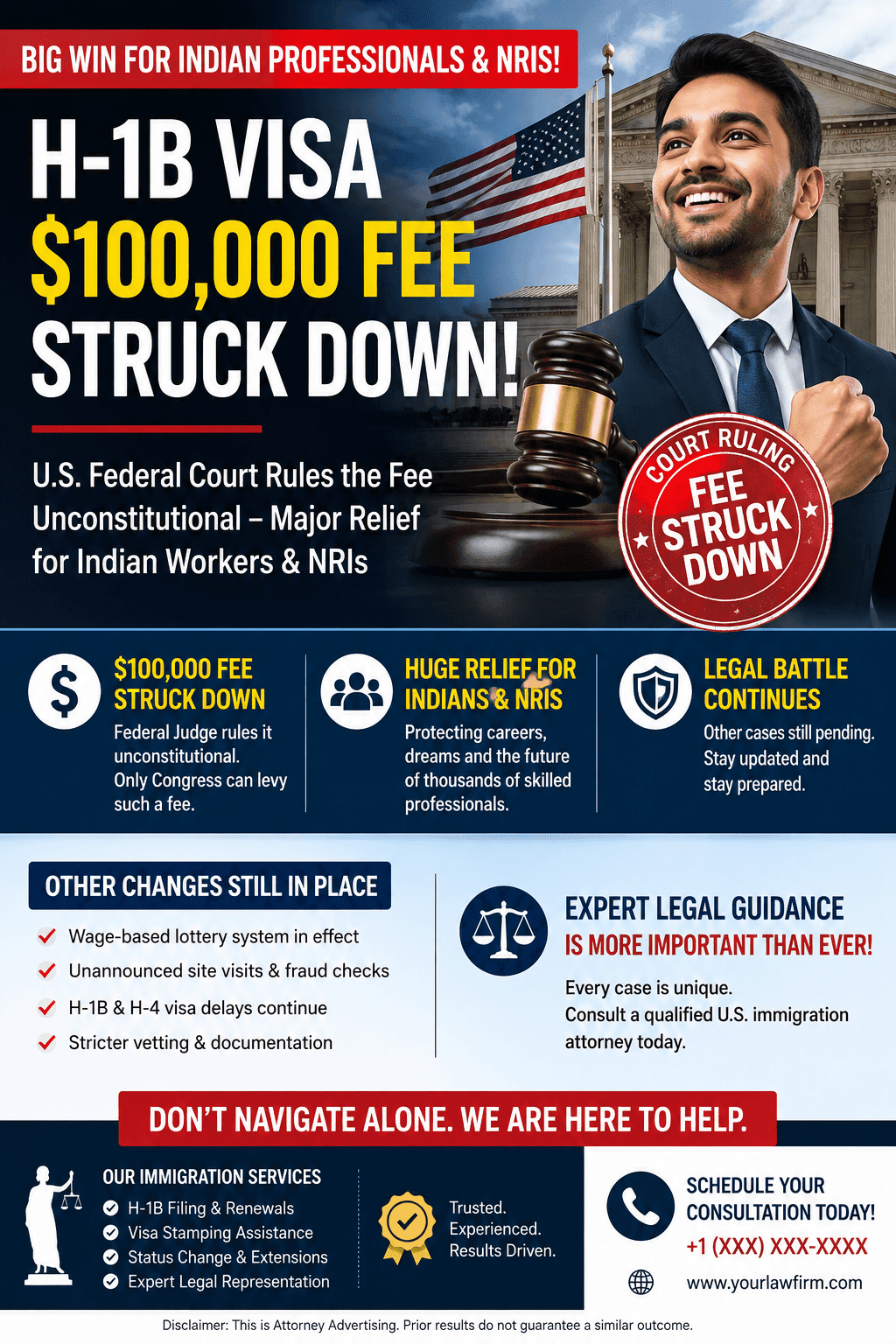
The H-1B visa fee struck down by a federal court in the United States has come as a massive relief for thousands of Indian skilled workers, NRIs, and IT professionals who were waiting anxiously for justice against one of the most damaging immigration policies in recent memory.
H-1B Visa Fee Struck Down — Here Is What Actually Happened
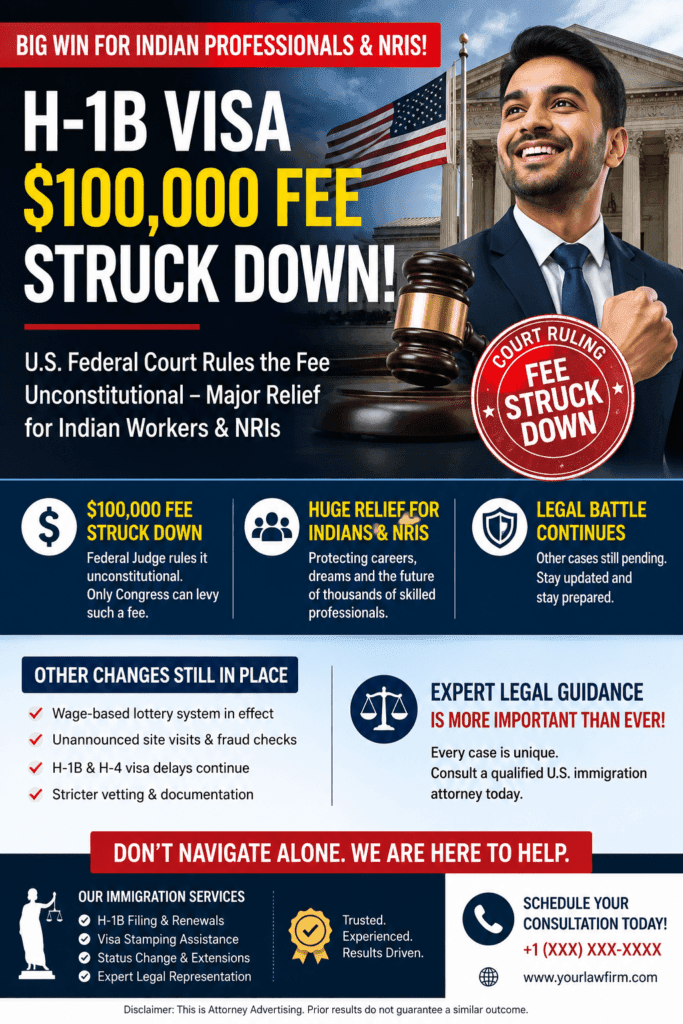
On June 8, 2026, a federal judge in Boston delivered a landmark ruling declaring the $100,000 H-1B supplemental fee unconstitutional. The H-1B visa fee-struck-down verdict came after 20 state attorneys general challenged the policy in court, arguing that the executive branch had no authority to impose such a massive charge without approval from the US Congress.
The judge agreed. The ruling clearly stated that the fee was essentially a tax—and only Congress holds the power to levy taxes under the US Constitution. With this, the H-1B visa fee struck down decision became one of the most significant immigration rulings of 2026.
Why the $100,000 Fee Was Introduced
Before understanding why the H-1B visa fee-struck-down ruling matters so much, it is important to know how this fee came about. In September 2025, the Trump administration announced a $100,000 supplemental fee on all new H-1B visa petitions filed from outside the United States.
For decades, employers had been paying between $2,000 and $5,000 to sponsor an H-1B worker. That cost suddenly jumped to over one lakh dollars overnight. The administration justified the move as a measure to protect American jobs and reduce dependency on foreign labor. However, critics called it a backdoor ban on skilled immigration.
H-1B Visa Fee Struck Down After Filings Collapsed Nationwide
The real-world impact of the fee was devastating. By early 2026, only 85 payments had been recorded under the new fee structure across the entire United States. This was a shocking collapse in filings — a number that would normally be seen in less than an hour during a regular H-1B season.
Tech companies, public hospitals, research institutions, and state universities all stopped or drastically reduced their international hiring. The H-1B visa fee struck down ruling comes as a direct response to this crippling effect on American industries that depend on skilled foreign workers, including tens of thousands of Indians every year.
H-1B Visa Fee Struck Down — The Legal Battle Behind the Victory
The lawsuit was filed by 20 Democratic state attorneys general who argued that the $100,000 charge was unconstitutional and damaging to public services. States specifically highlighted that the fee was preventing them from hiring teachers for primary and secondary schools, staffing public universities, and recruiting doctors and medical researchers.
The court sided with the states. The H-1B visa fee struck down order concluded that the Trump administration violated the Administrative Procedure Act by bypassing the proper regulatory process. The judge ruled that imposing such a fee without congressional delegation of authority was simply unlawful.
Is the Fight Over After H-1B Visa Fee Struck Down?
Not entirely. While the H-1B visa fee struck down ruling is a huge win, the legal battle is far from finished. Separate cases are still active in federal courts in Washington DC and San Francisco. Different judges in these courts could reach entirely different conclusions, creating a split in rulings across multiple appellate circuits.
Additionally, the fee was originally set to expire in September 2026 unless extended by the administration. Legal experts widely expect this matter to eventually reach a higher appellate court, or possibly the Supreme Court, before a permanent national resolution is achieved.
Other H-1B Changes That Remain in Place Even After H-1B Visa Fee Struck Down
Indian professionals must understand that the H-1B visa fee struck down ruling only removes the $100,000 fee. Several other major changes to the H-1B programme are still firmly in effect for 2026 and beyond.
A new wage-based lottery system is now operational, favouring applicants with higher salary offers over lower-paid registrations. Enhanced fraud detection site visits by immigration officers are being conducted at employer locations without prior notice. H-1B and H-4 visa interview appointments at Indian consulates continue to face significant delays due to expanded vetting requirements introduced earlier this year.
What Indian Professionals and NRIs Must Do Now
For the Indian community in America, the H-1B visa fee struck down decision is undoubtedly positive news. However, the overall H-1B landscape in 2026 remains highly unpredictable and legally complex.
Anyone with a pending H-1B petition, an upcoming renewal, or plans to apply for the first time must consult a qualified US immigration attorney immediately. Avoid unnecessary international travel unless all visa documents are completely current and valid. Stay closely updated on appellate court developments, as further rulings could change the situation rapidly.
The H-1B programme has always been the most important legal pathway for Indian talent entering the United States. With the H-1B visa fee struck down by the courts, that pathway is somewhat clearer today — but navigating it in 2026 still demands careful planning, expert guidance, and constant vigilance.
Tags: H-1B visa, US immigration 2026, NRI news, Indian professionals USA, H-1B fee ruling
This article is for informational purposes only and does not constitute legal advice. Readers are advised to consult a licensed US immigration attorney for guidance specific to their situation.
About The Author